Saturday, 2 October 2010

Facets of the shin


Part-finished crucifix figures, Upper Rhenish, c. 1500. Historisches Museum, Basle.

Which are most instructive for the shaping process, stripped down as they are to facets and an outline.
Technical thoughts:
Few of the facets are directly facing the viewer, which may contribute to the sense of jutting 3d form.

The mannered shins are , especially in the second figure, impossibly attenuated and give full play to the curved blade of the tibia. The tensile strength in the wood can be felt, as a tense, brittle stiffness. There is great discomfort in the toes. In each figure at the stage where the carving was abandoned the leg on our left is more curvaceous and expressive.The leg on our right in each case is cut very straight, perhaps to maximise the straight grain, and being behind, is more load-bearing.

The drapery is surprisingly well finished on the left, and would have been rather vulnerable during the remaining carving.

Thursday, 30 September 2010

Worse things happen at sea


The Royal Navy 's 19th century medical journals have been made available by the National Archive

Wednesday, 29 September 2010

Sardines


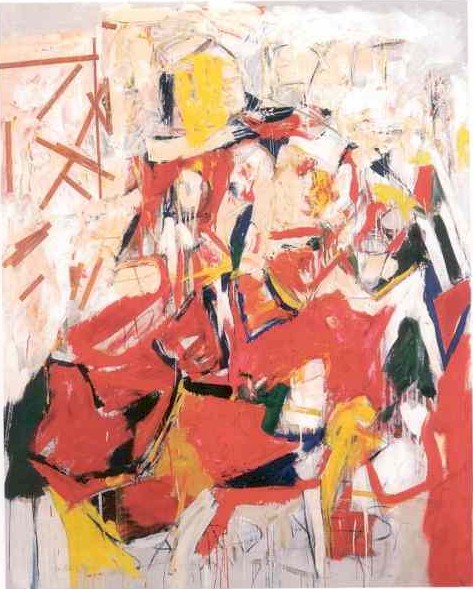
Mike Goldberg's "Sardines", the subject of Frank O'Hara's "Why I am not a painter"


More O'Hara images here

Why I Am Not a Painter

I am not a painter, I am a poet.
Why? I think I would rather be
a painter, but I am not. Well,

for instance, Mike Goldberg
is starting a painting. I drop in.
"Sit down and have a drink" he
says. I drink; we drink. I look
up. "You have SARDINES in it."
"Yes, it needed something there."
"Oh." I go and the days go by
and I drop in again. The painting
is going on, and I go, and the days
go by. I drop in. The painting is
finished. "Where's SARDINES?"
All that's left is just
letters, "It was too much," Mike says.

But me? One day I am thinking of
a color: orange. I write a line
about orange. Pretty soon it is a
whole page of words, not lines.
Then another page. There should be
so much more, not of orange, of
words, of how terrible orange is
and life. Days go by. It is even in
prose, I am a real poet. My poem
is finished and I haven't mentioned
orange yet. It's twelve poems, I call
it ORANGES. And one day in a gallery
I see Mike's painting, called SARDINES.

(1971)


Tuesday, 28 September 2010

A bone of which I am fond


....is the calcaneus, or human heel bone. Many years ago an old friend made me aware of its robust , compact form and surprising size when he showed me x rays of his: a rock guitarist, he had, intoxicated in the moment of performance, stepped off the front of an 8-foot high stage and, landing heel first, shattered it. Pinned, it was clumped back together and he hobbled in plaster for months. Until then, I had never really paid it any attention when drawing skeletons as an art student. Now I know it as the anchor of the Achilles tendon, and knowledge of it is key to drawing or sculpting convincing feet.

As a by-product of my search for crucified legs images whilst carving the lower half of my dying man for Belgium, I found an archaeological calcaneus, of a man in his 20s found at Givat'ha Mivtar, a Jewish district in North - East Jerusalem from about the time of Christ. The nail is 11.5cm long and bent against a knot in the upright of the cross after it was hammered through the bone. Note the nasty practicality of the wooden washer between the ankle and the head of the nail, designed to stop the victim from pulling his leg away sideways, a carpenterish refinement of the procedure. The legs were either nailed to the sides of the upright, or doubled sideways against the front of the cross as shown above. The calcaneus must have proved solid enough to support the body, whereas passing the nail through between bones would not. A torturer's knowledge of anatomy never ceases to impress me - but then, they must have had a lot of experience.

Friday, 3 September 2010

Tomoaki Suzuki


Sculpts very recognisable friends in wood, rather small. He sculpted the sister of an ex-student of mine. His gallery is Corvi - Mora.

Wednesday, 1 September 2010

Statue of Newton at Trinity Cambridge

And from my pillow, looking forth by light
Of moon or favouring stars, I could behold
The Antechapel where the Statue stood
Of Newton, with his prism and his silent face,
The marble index of a Mind for ever
Voyaging through strange seas of Thought, alone

(said Wordsworth after 1805)


1755, sculptor Louis Francois Roubiliac

Looking at details of facial anatomy


Today's task on the workbench had me running for more detail in the anatomy textbooks, as I worked on modelling up nasal cartilage that was both accurate and idiosyncratic, and lip muscles that did justice to the interlacing of muscle fibres into other muscle fibres and skin tissue that seems to happen . Buccinator was a surprise to me , being larger and shapelier than I had seen on specimens in the DR, and the accessory cartilages shown in the netter drawing of the nasal structure , while perhaps subject of individual variations, make me want to go back again and look at my embryological development books. They make me think of a coelacanth....
Some useful illustrations and resources here: